Kenya stands as a beacon of climate leadership in Africa, demonstrating that climate action and sustainable economic growth go hand in hand. Today, 93% of Kenya's electricity comes from renewable sources—geothermal, wind, solar, and hydro. Kenya is expanding investments in e-mobility, climate-smart agriculture, clean cooking solutions, and green manufacturing while pioneering nature-compatible solutions such as sustainable waste management and circular economy interventions.
Kenya is pairing clean supply with demand-side energy efficiency to keep growth affordable and reliable: scaling time-of-use tariffs and peak-shifting programmes, strengthening economy-wide action through the National Energy Efficiency and Conservation Strategy, and targeting system performance improvements that can unlock significant savings. Through bold climate action underpinned by energy efficiency, Kenya is building a climate-resilient society that serves as a model for inclusive, sustainable growth across the continent - embedding efficiency across agriculture, energy, infrastructure, livelihoods, sustainable mining, and emerging areas like artificial intelligence—Kenya is creating a comprehensive approach to sustainability.

Access to electricity (2023)

National energy intensity (2022)

Share of non-fossil capacity in total installed power generation capacity (2025)
Rapidly rising electricity demand and system pressure
Kenya’s electricity demand has been growing at 5–7% annually, driven by urbanisation, industrialisation, and rising appliance ownership. Peak demand exceeded 2,300 MW in early 2025, up 6.4% year-over-year, with long-term trajectories suggesting it could more than double by 2040 under current trends. Energy efficiency, particularly in buildings, appliances, and grid infrastructure, can reduce demand growth while improving system reliability and reducing costly losses.

Efficiency Supports Electrification Efforts
Kenya aims to connect around 5.1 million additional households by 2030, placing growing pressure on the electricity system. Electricity demand from light industry, appliances, and cooling is projected to quadruple by 2040, making energy efficiency essential to lower costs, improve reliability, reduce the need for new generation and grid infrastructure, and ensure electrification delivers more inclusive and resilient economic growth.

Efficiency Is a Core National Priority
The Kenya National Energy Efficiency Conservation and Strategic Plan provides clear action and timelines for energy efficiency. In 2025, the National Energy Compact 2025–2030 sets a clear course: double the rate of energy efficiency improvement, reduce energy intensity by 2.8% annually, and bring system losses down from 23% today to 15% by 2030. Each percentage point saved delivers the same impact as a new power plant, without the cost or environmental footprint.


ENERGY EFFICIENCY


EFFICIENT COOLING


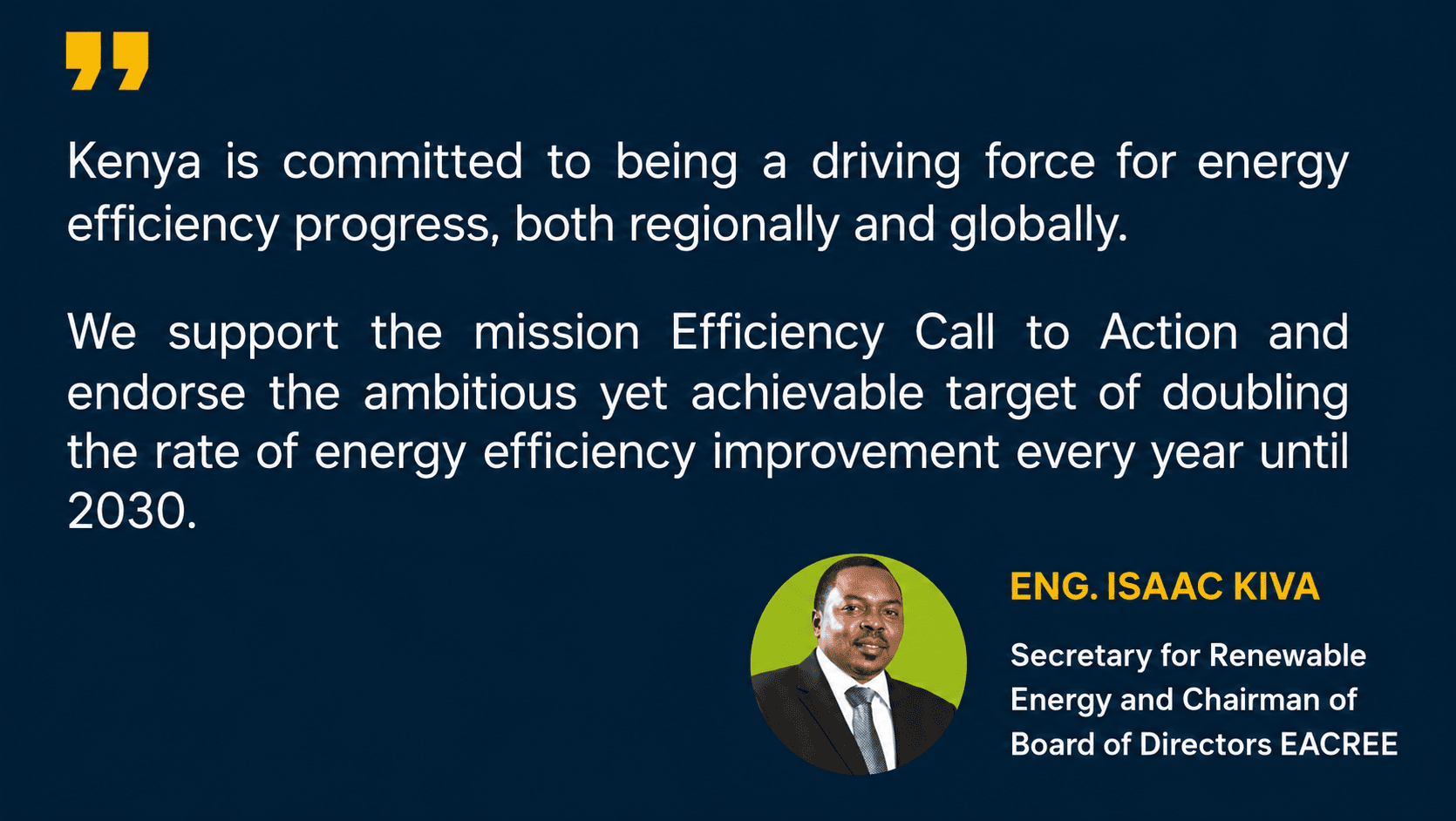
Positioning Kenya as a global and regional energy efficiency champion.Kenya has endorsed the Mission Efficiency Call to Action, the COP28 Global Renewables and Energy Efficiency Pledge, and the Global Cooling Pledge,demonstrating its commitment to accelerating energy efficiency and sustainable cooling

Strengthening national and local capacity to deliver energy efficiency. Technical assistance has supported the National Energy Efficiency and ConservationStrategy Implementation Plan, the National Cooling Action Plan, county energy planning, and South-South knowledge exchange.


Building investment pipelines for energy efficiency. Support identifies bankable projects, strengthens their investment readiness, and connects them with financiers through the Marketplace.